
Find Property Lines Before Repairing a Canal-Side Seawall
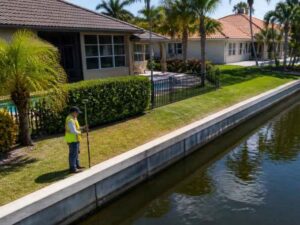
A failing seawall on a canal is a repair you can’t put off for long. But before crews touch it, you need to find property lines that show where your land actually stops. Canal-side lots are tricky, since the water’s edge, the wall, and the legal line rarely sit in the same place. Fix past your boundary and you can end up on a neighbor’s lot or inside a public canal area. For developers, confirming the lines first prevents stop-work orders, redone work, and fights with the water district. This guide covers why the lines matter, where the seawall sits versus the boundary, canal easements, the measurements to check, and when to order a boundary survey.
Why Property Lines Matter Before Seawall Repairs
You confirm the property lines first because a seawall often sits near a boundary, and repairing past that line puts your work on land you don’t control. A canal lot can share edges with a neighbor, the water, and a public canal tract all at once. That makes the true line harder to guess than on a normal inland lot.
Building beyond your line creates real problems. Work that spills onto a neighbor’s parcel is an encroachment they can force you to undo. Work that pushes into a public canal or its maintenance area can trigger a violation from the water management district. Most canal repairs need a permit, and the permit often depends on showing the work stays inside your rights. Knowing the line keeps the repair legal and inside the area you actually own.
There’s a money side too. A wall rebuilt in the wrong spot may have to come out and go back in, which doubles the cost of the most expensive part of the job. A boundary dispute can also stall the whole project while lawyers sort it out. Spending a little to confirm the line up front is cheaper than either outcome.
Where the Seawall Sits in Relation to the Boundary
The wall you can see is not proof of the legal line, so a boundary survey compares the wall’s real position to the deed and the records. Old seawalls get built, patched, and rebuilt over the years. Any of those steps can leave the wall sitting inside, on top of, or past the true boundary.
The line itself may not be where you’d expect. On canal lots, the boundary can follow a platted line, a bulkhead line, or the mean high water line rather than the face of the wall. A surveyor ties the physical wall to the recorded evidence and shows the gap between them. That gap matters, because a repair that follows the old wall could follow a line that was never correct. Getting the real position on paper first keeps the repair from repeating an old mistake.
Water levels add another wrinkle. On tidal or managed canals, the edge of the water moves, so a line tied to water level is not a fixed mark you can eyeball. Only a survey pins that boundary to a stable reference. That’s why two neighbors can point at the same stretch of bank and each believe the line falls in a different place.
Canal Edges, Easements, and Other Boundary Complications
Canal lots come with extra layers, like easements, rights-of-way, and canal maintenance areas that a plain lot line doesn’t have. The strip along the water is rarely as simple as a line between two yards. Recorded interests can sit on top of your land and limit what you do there.
Drainage and maintenance easements are common along canals. They give the water district or another party the right to access the bank, which can restrict where you stage work or place anchors. The plat may show a separate canal tract, a bulkhead line, or submerged land that belongs to a public body. Riparian rights, which are the rights of a waterfront owner, can also shape what you can build at the edge. Check the recorded plat and the district’s rules early, since these details can move or shrink the area you’re allowed to repair.
A homeowners association can add one more layer. Many canal communities have their own rules on wall height, materials, and setbacks from the water. Those rules sit on top of the district and county requirements, not in place of them. Sorting out every interest before design keeps the repair from clearing one hurdle only to fail another.
Measurements to Check Before Choosing a Repair Area
Measure the wall, the boundary, the neighboring walls, and the open work area before you set the repair footprint. Start with where the existing wall sits in relation to your line. Then figure out how far a repaired wall would reach, since the fix is often bigger than the old wall.
A seawall repair can extend in both directions. A new cap or facing may push slightly toward the water, and tie-back anchors, called deadmen, reach back onto your land. Both need to stay within your rights and clear of easements. Check how the wall ties into the neighbor’s seawall on each side, because a shared or abutting wall adds another set of limits. Confirm the distance to any easement edge and the space you have for equipment and staging. Note the height of the wall and its cap too, since a taller rebuild can run into rules the old wall predated. Pinning these numbers down early keeps the repair plan realistic and inside the lines.
A Boundary Survey Before Work Begins
A professional boundary survey gives the owner and crew a clear map of where the property starts and stops before repair planning gets serious. The surveyor locates the corners, ties the seawall to the legal line, and shows the easements and canal interests that affect the work. Those marks in the field tell the crew exactly where they can build.
A survey earns its cost in a few clear cases. Order one when the line is unclear, when the wall sits close to a neighbor, when the permit requires a survey, or when the wall ties into a shared structure. The drawing feeds both the permit application and the repair design, so everyone works from the same facts. It also gives you a record to fall back on if a neighbor or the district questions the work down the road. After the work wraps, an as-built survey can confirm the repaired wall landed where it should, which helps close the permit and protect you if a boundary question comes up later.
For a free land surveying quote, call us at (954) 737-7509 or send us a message by going here.
Posted in land surveying, land surveyor | Tagged boundary survey